


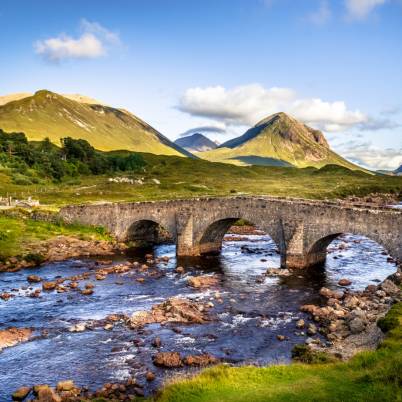
The Scottish Highlands are located northwest of a line drawn between Dumbarton near the head of the Firth of Clyde on the country’s west coast to Stonehaven on the east coast. The Inner and Outer Hebrides, and Bute and Arran islands are sometimes included in this division. The Highland area is different from the Lowlands in tradition and language, with the Gaelic language and customs surviving in the Highlands. That distinction was first noted in the late 14th century although the boundary between the two is not well defined. What we do know for certain is that Scottish Highlands are geographically diverse, home to some of Britain’s farmland, ancient forests and woodlands, rushing rivers, and undulating coastline with dramatic seascapes and islands.


A breathtaking and sparsely populated area, the Scottish Highlands is the largest geographical area in the country, spanning nearly 10,000 square miles. A must-visit on a Scotland vacation, it boasts incredible landscapes with remote wilderness areas, countless lochs, mountains, waterfalls, and spectacular coastlines with beaches looking as if they were stolen from the Caribbean. It’s home to Loch Ness where many search for the legendary “Nessie,” lake monster, along with hundreds of castles, many in ruins although others have been restored and transformed into hotels or living museums. While it would be impossible to see everything this incredible region offers in one trip, this guide to the Scottish Highlands will help you make the most of the time you have.
Geography of the Scottish Highlands

How Much Time to Spend in the Scottish Highlands?


As it is such a vast area you’ll want a week to explore the highlights of the Scottish Highlands. That will be enough for an enjoyable experience that provides a good taste of what it has to offer. No matter how long you visit, you’ll probably leave wanting more. In a week, you could visit Inverness and the nearby Culloden battlefield site, explore Loch Ness and Urquhart Castle, and perhaps enjoy hiking in Cairngorms National Park. From there, you might spend the remainder of your trip on the Isle of Skye. About a 2.5-hour drive from Aviemore in the Cairngorms, it’s well worth spending at least a couple of days as the country’s second-largest island with a wide range of attractions.
How to Get Around the Scottish Highlands

Many of the top attractions in the Scottish Highlands are spread far apart and can take a long time to reach via public transport. You’d probably miss some of the more remote, hidden gems traveling this way too, which makes driving the best way to get around. Plus, you can travel at your own pace, spending more time at favorite stops and less at others. That said, driving here can be more challenging, especially for those not used to driving on the left. There are many narrow single-track roads that require using passing places when encountering other vehicles. Taking a Scotland private tour with someone else behind the wheel is the best alternative although there are coach tours that cover the highlights.
Best Time to Visit the Scottish Highlands


The weather in the Scottish Highlands is always unpredictable but for the best chance of more pleasant temperatures and clear skies, visiting from May through September is best. Between October and April, gale-force winds, freezing temperatures, and snow are all possible. Don’t expect it to be balmy at any time. For example, in Inverness, the warmest month of the year is July with an average daytime temperature of just 58 degrees Fahrenheit. The busiest month in terms of tourism throughout Scotland is July and August. To avoid the biggest crowds in the Highlands while still enjoying at least decent weather, plan your visit anytime between May and early June or the second half of September, perhaps into early October.
Scottish Highlands Culture


Tartan kilts have become synonymous with Scotland, long associated with Highland dress. Today you’re unlikely to see many in the Highlands wearing kilts although it is more common during special occasions like weddings. The traditional Highland dress is characterized by the distinct pattern with bold patterns and colors which was originally regarded as a marker of power and wealth in medieval Gaelic society. Unlike the Lowlands where the language of the Scots was adopted, the Highlands have a long history of Gaelic with the language still spoken by many. Shinty, a sport similar to hockey, and the Highland Games have been part of Highland culture for generations, while traditional Highland music features the distinctive sounds of bagpipes, flutes, fiddles, and drums.
Scottish Highlands Local Cuisine


With abundant resources in the Highlands, you can expect lots of farm- and sea-to-table fare but there are some traditional dishes you’ll want to try. That includes a fish supper with the lochs and seas around the region teeming with fish. Fish ‘n chips is one of the most common dishes although you’ll be spoiled for choice when it comes to seafood with everything from lobster and crab to scallops and langoustine. The fertile land results in crops like potatoes and a wide variety of nourishing vegetables. Haggis is something everyone should try, often served with potatoes (tatties) and turnips (neeps). The Scottish breakfast is a must-try, with black pudding, tattie scones, fried eggs, baked beans, black pudding, and fried tomato toast.
Best Places to Visit in the Scottish Highlands

Glencoe

Isle of Skye
Loch Ness
The most famous loch in Scotland, Loch Ness is where the country’s legendary monster has long been said to reside. It’s possible to hike around the shoreline and there are cruises that will bring you to explore the deep lake while watching for “Nessie.” It’s the perfect way to get a perspective of the beauty along the loch shores, including the spectacular ruins of Urquhart Castle. The medieval castle ruins are worth a visit with the adjacent Loch Ness Centre & Exhibition reveals more about Scotland’s most mysterious sea creature. Be sure to climb Grant Tower overlooking the loch providing another good vantage point for spotting Nessie as well as the chance to peer down into an eerie prison cell.
Glencoe
The most famous glen in Scotland, and often called the most scenic, Glencoe boasts a landscape so stunning that it looks as if it was Photoshopped. Dramatic mountains like the Three Sisters and the cone-like Pap of Glencoe, waterfalls, and sparkling lochs entice one to explore. A hike through the lush valley brings nearly endless photo-ops, making it no surprise that climbers and hikers arrive from across the globe to take on the region’s multiple mountaineer routes that include eight Munros (a mountain over 3,000 feet in height). It’s also a wildlife lover’s paradise with pine martens, red deer, and golden eagles.
Isle of Skye
The Isle of Skye is one of the most popular destinations in the Scottish Highlands. The largest in the Inner Hebrides, it looks like a fantasy come to life. It’s easy to imagine fairies living in the knarled, hollowed-out logs among moss-covered trees while soaring mountains with legendary rock formations loom above. Waterfalls spill down sea cliffs while gentle streams form turquoise pools like the aptly named the “Fairy Pools.” Of course, there’s a castle. Dunvegan is the country’s oldest continuously inhabited castle, the ancestral home of the MacLeods for 800 years. Open for public tours the grounds boast lush gardens, and inside, you’ll see the sacred Fairy Flag that legend tells was responsible for the families’ miraculous victories in battle.
Inverness
The Highland capital is a popular base for exploring the Scottish Highlands with many attractions close enough for a day trip, including Cairngorms National Park, Loch Ness, and Culloden Battlefield. There are numerous whisky distilleries within a short drive for touring and tasting too. But Inverness offers plenty of its own. The River Ness winds through, ideal for tranquil riverside walks and the lively Victorian Market hosts many independent shops, most of which have been here for generations. Inverness Castle sits atop a cliff overlooking the river providing spectacular cliff top views and there are excellent museums like the Highlanders Museum at Fort George. It boasts an impressive display of artifacts from the Battle of Culloden through active regiments today.

Loch Lomond

Cairngorms National Park
Loch Lomond & the Trossachs National Park
Once roamed by outlaw Rob Roy MacGregor, Loch Lomond and The Trossachs National Park is an area of outstanding natural beauty. The many poems and tales inspired by local legends and the romantic landscapes have drawn visitors for centuries. Author Walter Scott called Loch Lomond, Britain’s largest lake, “The Queen of Scottish Lakes.” It’s long been a favorite spot for fishing with abundant trout, salmon, and whitefish. Swimming, kayaking, water skiing, boat tours, picnicking, and hiking or biking around its shores are a few of the popular activities that can be enjoyed. Visitors can also see some incredible birds of prey up close, including golden eagles and owls, at the Loch Lomond Bird of Prey Centre. Falconry activities are available too.
Cairngorms National Park
The largest national park in the United Kingdom, Cairngorms is an unspoiled mountain wilderness area home to five out of six of the highest peaks in Scotland, and four out of 10 of Britain’s highest. It’s filled with sapphire lochs and meandering rivers, native forest, and moorland as well as being inhabited with abundant wildlife. Wildcat, pine marten, deer, and golden eagle can all be spotted, plus it’s home to the only free-ranging herd of reindeer in the entire UK. Guided walks are available to see them. There are miles and miles of scenic trails to hike from the trek around Loch Muick to the route that will bring you to the summit of nearly 4,300-foot-high Ben Macdui.
Fort William & Ben Nevis
Ben Nevis is the highest summit in Britain, soaring more than 4,400 feet above the town of Fort William, a popular base for hiking. Climbing to the mountain’s summit is on the bucket lists of many whose reward is a view that stretches over 100 miles from the Grampian Mountains to Glencoe and all the way out to the Atlantic coast. On a clear day, Northern Ireland even comes into view. While there are multiple routes, the main route is good for those who aren’t up for a serious challenge, following the Pony Track that starts about 1.5 miles east of Fort William. It ascends the western flank, with a not-too-steep gradient most of the way.
Top Historical Sites in the Scottish Highlands

Urquhart Castle

Glenfinnan Viaduct
Urquhart Castle
Dating back to the 13th century, the ruins of Urquhart Castle are some of the most extensive in Scotland. Located on a headland overlooking Loch Ness, the castle featured prominently in the Scots’ struggle for independence in the 12th century. The grounds are rather vast and a visitor center with a large gift shop, a cafe, and a theater where you can watch an intro film into the history of the castle. Don’t miss it as it will help bring the ruins to life as you explore everything from the thick stone walls to the prison cell that once held legendary Gaelic bard Dòmhnall Donn. By climbing Grant Tower you can also take in an awe-inspiring panoramic view
Glenfinnan Viaduct
The Glenfinnan Viaduct near the scenic Glenfinnan village is a renowned feat of Victorian engineering and Scotland’s longest concrete railway bridge. At 1,000 feet long and 100 feet high, it dominates the landscape with 21 high curving arches serving as windows to the mountains peaking behind. Most know the viaduct from its appearance in the Harry Potter films. The “Hogwarts Express” train crossed it in the series, but in real life, it’s called the Jacobite Steam Train, traveling from the foot of Ben Nevis in Fort William to the fishing port of Mallaig. While the steam train itself is a popular ride, many visitors like to stand on the hill near the viaduct to capture a shot of it rolling through.
Dunrobin Castle & Gardens
Located along the east coast in the Northern Highlands overlooking the Dornoch Firth with towering conical spires that make it look like a French chateau, Dunrobin is one of the oldest continuously inhabited houses in Britain, dating to the 13th century. The family seat of the Earl of Sutherland, Chief of the Clan Sutherland, it was used as a naval hospital during the First World War and a boarding school from 1965 through 1972. There are beautiful gardens, falconry shows, and a museum for learning more about the castle’s history and the Highlands that includes a remarkable collection of Pictish stones and symbols. The stunning view of the beach, moors, and mountains from here is worth the visit alone.

Eilean Donan Castle
Eilean Donan Castle
If you drive the main route to the Isle of Skye, you can’t miss Eilean Donan, right before the bridge that links the island to the mainland. One of Scotland’s most iconic images, the 13th-century castle sits on a small island where three sea lochs meet. It was partially destroyed in 1719 as part of the Jacobite uprisings and stood in ruins for nearly two centuries until it was purchased in 1911 by Lieutenant Colonel John MacRae-Gilstrap and restored to its former glory. Every corner can be explored as it’s open for public tours but it’s also worth stopping just for a photo. There are several good vantage points, including the car park and just across the bridge at Dornie Community Hall
Culloden Battlefield
The Battle of Culloden occurred on a windswept moorland about 5.5 miles east of Inverness on April 16, 1746. Of the 1,300 men who were slain in under an hour, about 1,250 were Jacobites, mostly from the Scottish Highlands. It ended the series of Jacobite risings that had started in 1688 as well as putting an end to the male line succession of the House of Stuart on the British throne. The Scottish National Trust now protects the battlefield that’s been restored as close as possible to what it was like on that fateful day in the 18th century. The visitor center/museum features interactive displays and an extensive collection of artifacts from both sides of the battle.
Clava Cairns
Clava Cairns is a Bronze Age burial site near Culloden Battlefield with standing stones that surround circular mounds aligned with celestial events. Two of the cairns align with the sun during the winter solstice while the tallest faces the sunset in midwinter to the southwest. The site has become extremely popular after being used as a filming location for the “Outlander” TV series, with countless fans visiting to take photos with the stones and attempt to go through them, hoping to find James Fraser (Sam Heughan). The site is open 24 hours a day, 365 days a year but it’s important to remember that this is a protected historic site and burial ground, and she should be treated with respect.
Outdoor Activities in the Scottish Highlands


Hiking & Walking
Hiking and walking are the Highlands’ top outdoor activities. West Highland Way is one of the most famous, a long-distance route covering 96 miles from Milngavie to Fort William, passing Loch Lomond, Rannoch Moor, and the Devil’s Staircase. But you’ll find countless day hikes and shorter treks. The Glen Strathfarrar Munros Circuit near Inverness offers the chance to bag a Munro although it is a challenging loop that traverses 15.5 miles and can take up to 10 hours to complete. The Reelig Glen walk travels along the Monaick Burn, a small river, through the woodland and old conifers of Reelig Glen, including some of Scotland’s tallest trees. It’s only a mile-long circuit and includes a 19th-century stone bridge and grotto.
Wildlife Watching
The Scottish Highlands are home to abundant wildlife that can be seen everywhere from the unspoiled countryside to nature rivers, forests, lochs, and the sea. Cairngorms National Park is a great place to see birds of prey like ospreys, falcons, and golden eagles. Watch for deer, wildcat, pine marten, and red squirrels too. You can even visit the Cairngorm reindeer herd via hill trips from Aviemore. Watch for puffins at many locations along the north coast during the breeding season between April and September. Puffin Cove near Melvich boasts the largest colony on the mainland. The Moray Firth near Inverness is home to the world’s most northerly dolphin population with about 200 bottlenose dolphins. Boat tours can bring you to spot them.
Watersports
Between the sea, the lochs, and the rivers, the Scottish Highlands offer a wide range of watersports. Stand-up paddleboarding, or SUP, is one of the most popular, bringing the chance to soak up the surrounding scenery from the water. There is nearly an endless list of places to enjoy it, including the lochs and shorelines of Oban and Fort William. This is a paradise for paddlers with kayaking and canoeing available in lochs and rivers across the Highlands, including Loch Morlich near Aviemore in the Cairngorms and the Great Glen Canoe Trail near Inverness, running from coast to coast. If you can brave chilly waters, swimming is possible throughout the Highlands, including Loch Morlich and Alchmelvich Beach in the far north-west.
Cycling & Mountain Biking
The Scottish Highlands offer some of the world’s best mountain biking with nearly an endless list of options that will allow you to explore the spectacular scenery, including the Highland Wildcat Trails. Tucked on the slopes of Ben Bhraggie in Golspie, about an hour north of Inverness, there are options for all levels. If you’ve got the energy, pedal to the top of the Ben for stunning views of the Moray Firth coastline and its numerous beaches. Cycling routes include everything from family-friendly to challenging long-distance rides like the Great Glen Way from Fort William in the southwest to Inverness. The Muir of Ord loop from Inverness showcases scenic views on an easy, under 27-mile ride with mostly well-paved surfaces.


Climbing & Mountaineering
The Highlands call many to “bag a Munro,” reaching the summit of one of the many over 3,000-foot-high mountains. That includes everything from Ben Nevis to the Pap of Glencoe and beyond. The Isle of Skye is home to legendary Cuillin Ridge drawing mountaineers from across the globe with 12 Munros for a challenging test of skills. During the winter, Glencoe is a mecca for experienced ice climbers. Rock climbing is possible throughout the Highlands with something for everyone from beginners to the advanced. You’ll find climbing walls for learning the ropes and some of the finest crags in the country offering multi-pitch climbs. Introductory sessions and advanced courses are available from Aviemore in the Cairngorms via Highland Outdoor Adventures.
Skiing & Snowboarding
With all those mountains, it’s no surprise that skiing and snowboarding are popular in the winter. Glencoe Mountain Resort is the oldest ski center in the country having opened in 1956. It also boasts some of the most impressive views, located on Rannoch Moor. It has a natural bowl with a large plateau area ideal for beginners and there are slopes for intermediates too. It’s an outstanding venue for experienced snowboarders with the upper mountain offering some great runs that include the steepest black in the UK. In Fort William, Nevis Range offers skiing and boarding that lasts into the spring with something for all levels of experience, including the famous steep runs of the Back Corries to challenge the experts.
Golf
As the birthplace of golf, many enthusiasts come to enjoy the sport and the Highlands offer some of the country’s very best. Royal Dornoch’s Championship Course often tops the list and ranks high on the list of Golf Digest’s “World’s 100 Greatest Golf Courses,” most recently falling in at No. 2. Nestled among the dunes along the shoreline of the North Sea it’s also one of the world’s most natural courses. Set along the Moray Firth, Nairn is one of the most magnificent seaside courses with sea views from every hole. The only downside is that dolphins are often spotted in this area which might be a bit distracting, especially when playing the first seven holes which are directly along the water.
Discover Our Scotland Private Tours
-
Explore This Trip

Edinburgh & the Scottish Highlands
Edinburgh, Perthshire
7 NightsFrom £5,155 PPOn this enchanting 7-night trip, you’ll explore Edinburgh, one of the most beloved cities in Europe,... -
Explore This Trip
Discovering London & Edinburgh
London, Edinburgh
10 NightsFrom £6,665 PPThis unforgettable tour provides an in-depth look at two of Europe’s most cosmopolitan cities,... -
Explore This Trip
Edinburgh Getaway
Edinburgh
5 NightsFrom £2,325 PPAs one of the most beautiful cities in Europe, Edinburgh is a top tourist destination with something...


COPYRIGHT © 2026 UNFORGETTABLE TRAVEL. ALL RIGHTS RESERVED
©2026. Travel + Leisure® is a registered trademark of Travel + Leisure Holdco, LLC, a subsidiary of Wyndham Destinations, Inc. Travel + Leisure® World’s Best Awards is used under license. Travel + Leisure® is published by TI Inc. Affluent Media Group, a Dotdash Meredith company, which is not affiliated with Wyndham Destinations, Inc. or its subsidiaries.